Running combat at the table
Before a fight starts, the encounter builder checks whether it is actually fair for your party. Once it starts, the live tracker holds initiative, hit points, and conditions for the whole table.
Building a fair encounter
Pick monsters from your library, set how many of each, and a difficulty verdict, Trivial through Deadly, updates as you go. It is measured against your actual party, using their current levels, hit points and condition. If someone is already down a few spell slots from earlier that day, the verdict reflects that when you ask it to.
For a harder read than the instant verdict, "Simulate this fight" runs the encounter five hundred times and reports back a win rate, an average number of rounds, and which characters were most likely to go down or die. Every encounter can be saved to a library and reused, and a saved encounter is started with one click once you are ready to run it.
Running the fight
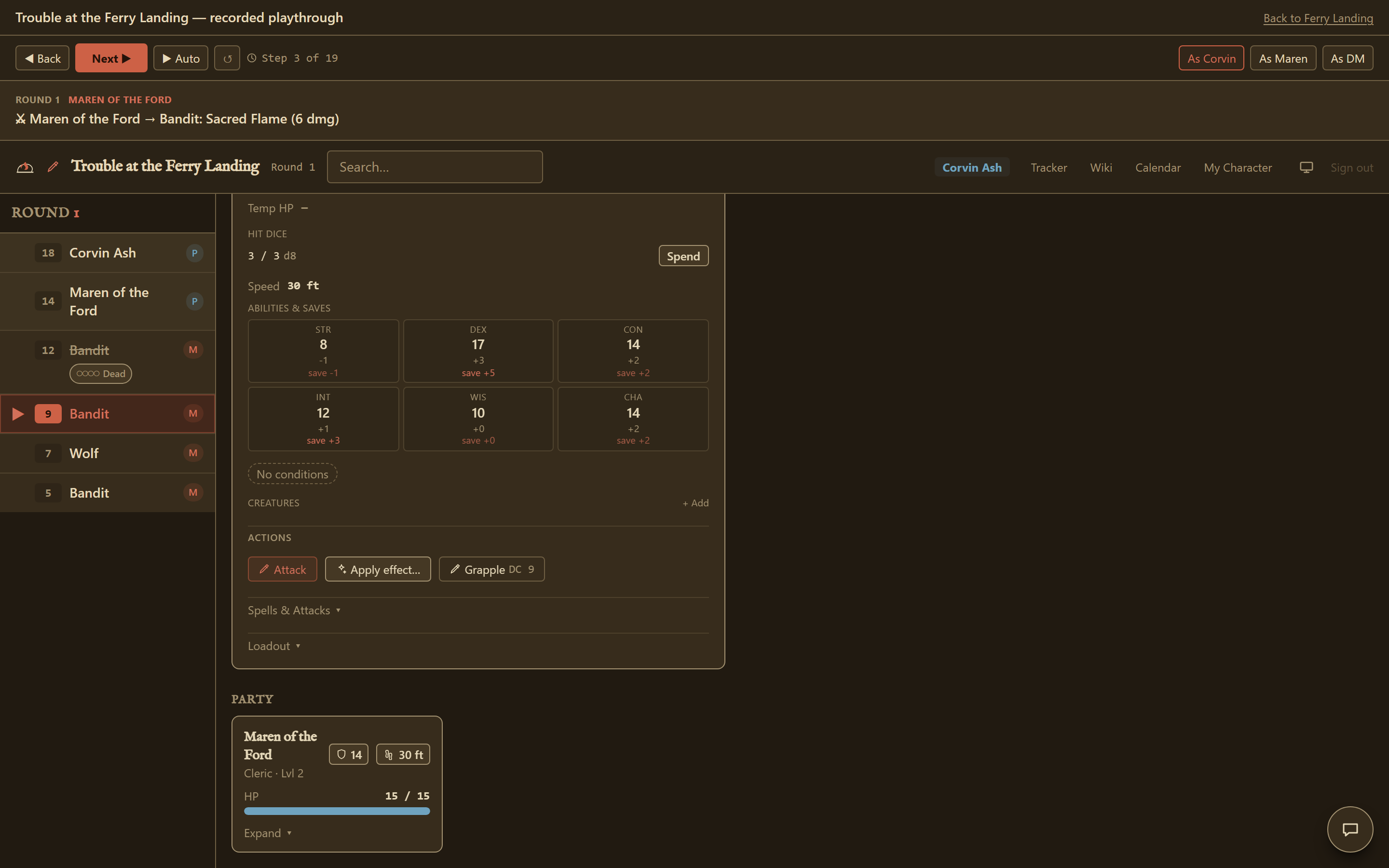
The live tracker holds initiative order, hit points, conditions, and spell slots for everyone in the fight, and tracks death saves the moment a character drops. You can add a monster mid-combat and slot it into initiative without restarting anything. Ending the encounter opens a loot window where you assign items and coin to characters, or roll a treasure hoard by its denomination, and everyone's hit points and slots carry forward exactly as the fight left them. Hoard rolls come from the treasure-hoard pack, which is in your content catalogue and takes one click to install.
What players see
A player's own character card is theirs to update, hit points, conditions, spell slots and death saves included, straight from the tracker. Monster cards show a name and its place in initiative. No hit points, AC or conditions are shown, unless you turn on a coarse health indicator (healthy, bruised, hurt, dying, dead) that never reveals the actual number.
Manual or automatic math
A campaign-wide setting decides how damage gets entered. Table-math, the default, takes the finished number you already worked out and touches nothing. Roll-math takes the raw die result and adds the character's modifier plus your campaign's critical-hit rule for you. Both apply to damage and healing; saving throws, death saves and initiative are always just compared to a target number, so there is nothing for either mode to add.
The public demo has a recorded fight you can play back through the real tracker, from the DM's seat or either player's.