Creating your own content
You can add your own content beyond what ships with the platform: spells, items, feats, subclasses, monsters and more, through the same kind of guided form the rest of the wiki uses. The character sheet and the tracker run your content with the same engine that runs the official material: the engine looks content up by name and never asks whether it was yours or came in a pack.
What you can build
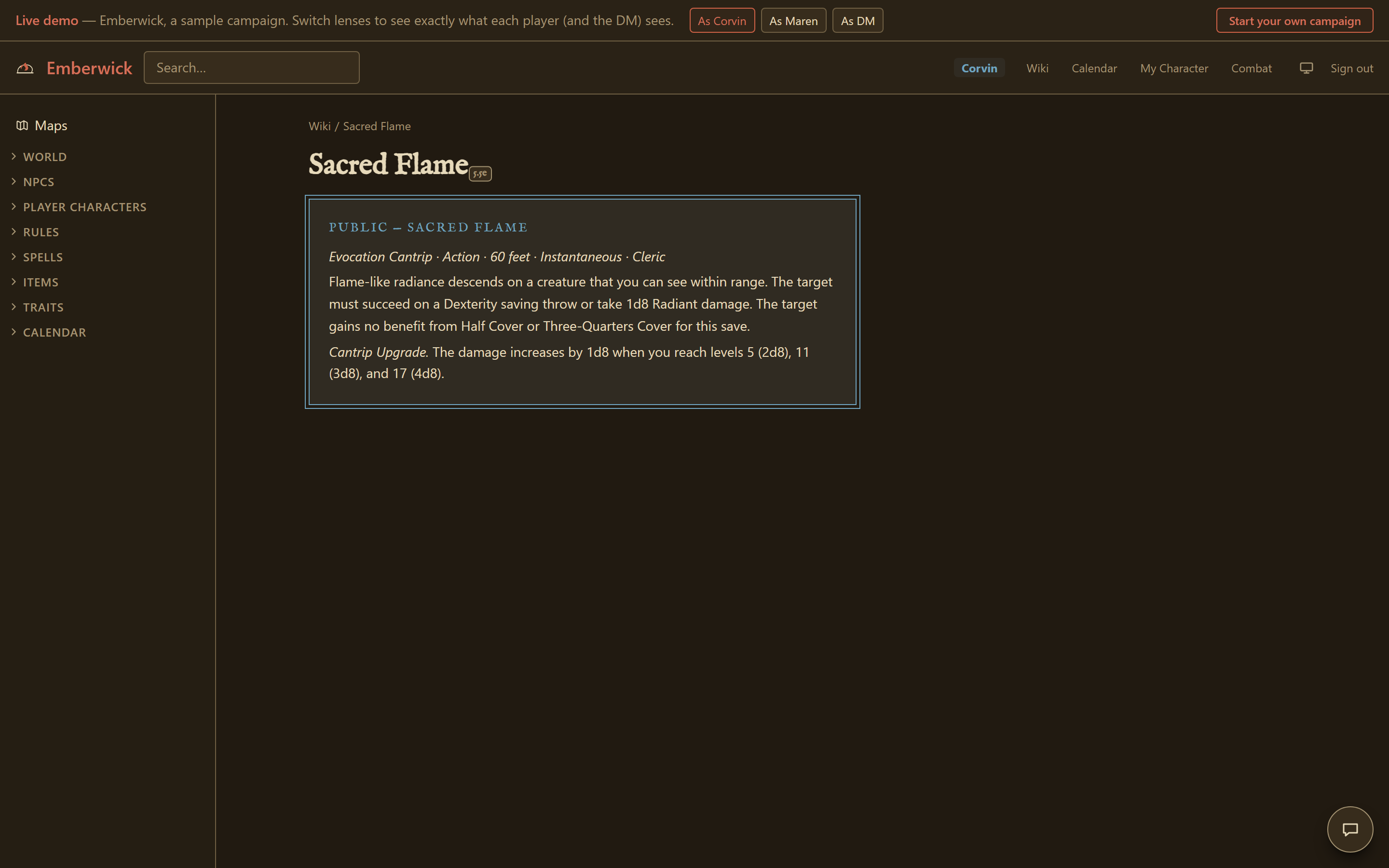
Open Create from the admin area and pick what you are making. Each type has its own form that asks only for what that thing needs, and a saved entry is live the moment you save it: a spell is castable, an item equippable, a monster ready to drop into an encounter. You can author:
- Spells, with their damage or healing.
- Items: plain weapons and armor with real profiles, and magic items with a rarity, an attunement requirement, and charges.
- Feats, species traits, background features, and single class or subclass features.
- A whole subclass: its umbrella and each of its level-gated features.
- Monsters and NPCs, as full statblocks with attacks, saves, and legendary actions.
- Custom conditions, affliction tables, and loot tables.
- Item collections you hand to a character in one click.
- Your own calendar.
To start from something that already exists, clone it and change what you need. To change one you made, edit it in place.
Subclasses, and where the line is
Subclasses are yours to write: a subclass you create shows up in the character builder for its class straight away, and its features arrive at the levels you set, the same as a built-in one would. Whole base classes are the one thing you cannot author. The twelve classes are a fixed chassis the rest of the system is built on. Subclasses are how you extend them.
Magic items
The item form covers the common shapes directly: a mundane weapon or armor with its real profile, or a magic item with a rarity, an attunement requirement, charges, and an activated effect that deals damage or heals. An item that adds a flat bonus (a +1 sword, or a ring that grants +1 to AC and saves) is written in the raw editor. Once it is, it applies on the sheet automatically: equip it and the bonus is there, with nothing to add up by hand.
How the rules engine runs it
The engine automates a defined set of things: casting, conditions, charges and attunement, curses, loot, the calendar. Anything inside that set behaves the same whether you wrote it or it shipped with the platform. A custom condition is the clearest case: you pick from the same mechanical effects the built-in conditions use, from advantage and disadvantage to resistances and changes to speed and saves, and it applies to whoever has it on its own. Anything outside that set installs as plain, readable text: a rule the engine cannot run is still written down where everyone can read it. The guided forms cover the shapes most content needs, and the raw editor, the same markdown the whole wiki is written in, is there for the rest.
Sharing what you make
Everything you author is ordinary content in your campaign, so it travels with it. Your homebrew is part of the pack you export, and it imports into another campaign the same way official content does.
Authored content follows the same visibility tiers as everything else: most of it starts staged, and monster statblocks stay DM-only, so nothing you are still working on reaches a player by accident. The wiki guide covers the tiers.